
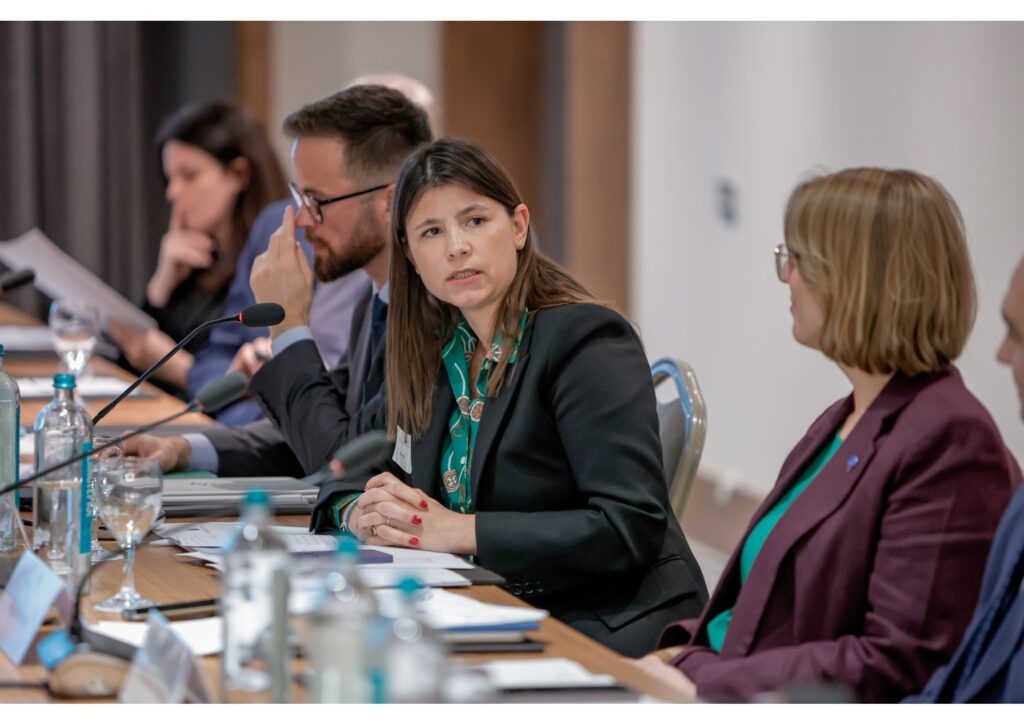
Barbara Frey, Marie Skłodowska-Curie Postdoctoral Fellow at the University of Rijeka’s Centre for Peace and Conflict Studies (CSMK), participated in the regional conference “Security in the Western Balkans”, organised by Aspen Institute Germany in Skopje, North Macedonia, from 18 to 20 November 2026, in cooperation with the Ministry of Foreign Affairs and Foreign Trade of the Republic of North Macedonia.
As part of the conference programme, Barbara Frey presented her policy paper “Geopolitical Security, Energy Transition, and Resource Dilemmas in the Western Balkans” and participated as a panelist in the session on Energy and Resource Security. The session addressed the region’s energy vulnerabilities, dependence on external suppliers, diversification of energy systems and the growing strategic importance of critical raw materials.
Her contribution examined how the green transition is reshaping the geopolitical and economic position of the Western Balkans. It highlighted the interconnected challenges of energy security, access to critical raw materials, foreign ownership and control of strategic assets, and the risk that new investment and supply-chain relationships could create additional forms of dependency. The discussion also addressed the importance of responsible resource governance and the need to connect energy and resource security with long-term economic development and institutional resilience.
The conference brought together participants from the Western Balkans, Germany, the EU and international organisations for discussions on the region’s changing security environment. Its programme covered defence cooperation, cybersecurity, information security, energy and resource security, and the protection of critical infrastructure. The event was organised as part of Aspen Institute Germany’s SECURE project, with support from the German Federal Foreign Office.
Barbara Frey’s participation contributed to the exchange between academic research and policy discussions on the geopolitical implications of the green transition in Southeast Europe. These issues are central to her research within ENVIJUST-WB, the Horizon Europe-funded Marie Skłodowska-Curie project at the University of Rijeka.