
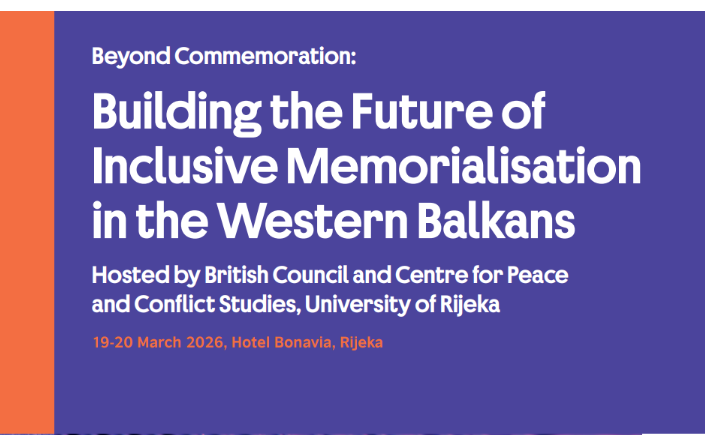
The British Council and the Centre for Peace and Conflict Studies at the University of Rijeka will host an international conference titled “Beyond Commemoration: Building the Future of Inclusive Memorialisation in the Western Balkans”, bringing together practitioners, researchers, artists, and policy experts from across the region to discuss new approaches to remembering the past, as an important element of a stable, long-term peace.
The conference will take place 19–20 March 2026 in Rijeka, gathering more than 70 participants from Bosnia and Herzegovina, Croatia, Serbia, Montenegro, Kosovo, and several European countries who are working in the fields of museums, education, arts, research, and civil society. The award-winning film director Nebojša Slijepčević, best known for his 2024 short film “The Man Who Could Not Remain Silent” which won the Cannes Palme d’Or, European Film Award, and César Award, will also join the conference.
Participants will explore how societies can address the legacy of the 1990s conflicts in ways that foster dialogue, empathy, and civic responsibility. The event will focus particularly on approaches that make memorialisation more inclusive by incorporating perspectives that are often absent from dominant public narratives, including the experiences of women, minority communities, and individuals who acted in solidarity across ethnic lines during the wars.
The conference forms part of the regional programme “Different Memories, Shared Futures: Inclusive Memorialisation in the Western Balkans”, implemented by the British Council in cooperation with partners across the region, and funded by the UK Government. The programme supports cultural, educational, and research initiatives that seek to broaden the space for dialogue about the past and encourage cross-border learning among practitioners.
The programme itself is supported as part of the broader framework of the Berlin Process, a European initiative aimed at strengthening regional cooperation, democratic culture, and people-to-people exchange in the Western Balkans. By bringing together practitioners from across the region to reflect jointly on how societies remember difficult histories, the programme contributes to the Berlin Process objective of fostering cooperation, reconciliation, and shared future-oriented dialogue, building foundations for lasting stability and security. Different Memories, Shared Futures is a direct deliverable of the meeting of Berlin Process Foreign Ministers – including the Western Balkan six countries and Croatia – in Belfast in October 2025.
Over the course of two days, participants will discuss the challenges facing memorialisation work in polarised societies and explore possibilities for future collaboration between organisations, institutions, and international partners. Sessions will focus on the role of museums and oral history projects, storytelling and artistic practice, and capacity building for professionals working with difficult histories, contributing directly to a lasting peace and stability.